Waste Not, Experiment Often: How Home Cooks Are Collectively Reimagining Sustainable Food Practices
A Different Kind of Laboratory
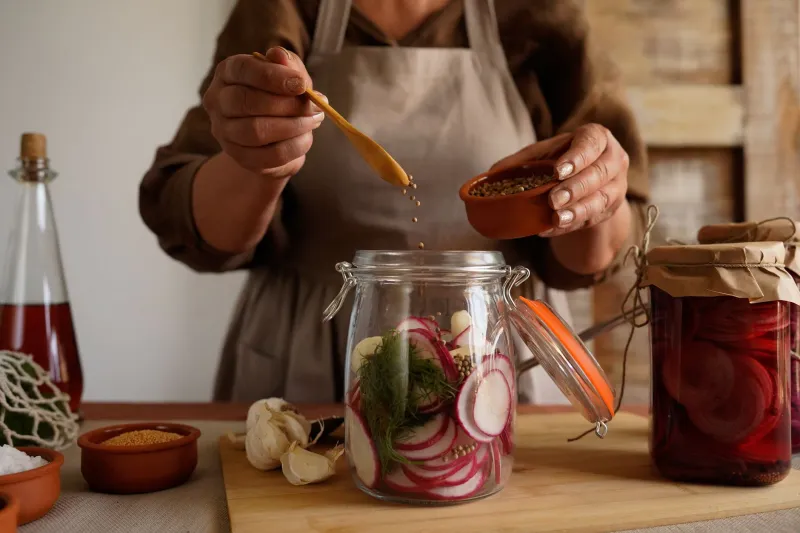
The countertop of Maya Okonkwo's Chicago apartment does not resemble a professional kitchen. Lined with mason jars filled with fermenting vegetable scraps, hand-labeled containers of dehydrated citrus peel, and a well-worn notebook dense with margin annotations, it looks instead like the workspace of someone engaged in serious, purposeful inquiry. Okonkwo, a middle school art teacher with no formal culinary training, describes herself simply as someone who got tired of throwing food away.
"I started asking questions online," she explains. "And I realized thousands of other people were asking the same ones. So we started answering them together."
Okonkwo is one of a rapidly growing cohort of Americans who are transforming domestic food preparation into a site of collaborative, community-driven research. Motivated by a combination of environmental concern, economic pragmatism, and intellectual curiosity, these home practitioners are developing and refining practical techniques for reducing food waste — and sharing their results through platforms, local groups, and informal learning networks that operate largely outside institutional channels.
The Scale of the Problem They Are Tackling
The urgency underlying this movement is difficult to overstate. According to the United States Department of Agriculture, between 30 and 40 percent of the American food supply is wasted annually — a figure that translates to roughly 133 billion pounds of food discarded each year. Much of that loss occurs not at the industrial or retail level, but within individual households. Wilting produce, forgotten leftovers, and improperly stored staples account for a significant share of the total.
For many participants in these collaborative networks, confronting that statistic personally was a catalyst. The question they began asking — what can actually be done at home, with ordinary equipment and modest resources? — turned out to be far more generative than any single individual could answer alone.
Platforms as Laboratories
The infrastructure of this movement is largely digital, though it consistently finds expression in physical spaces as well. Online forums, dedicated subreddits, and private Facebook groups have become gathering points where participants document experiments, solicit feedback, and iterate on shared techniques. A thread proposing a new method for fermenting spent grain from home brewing might accumulate dozens of responses within days, each adding a variation, a caution, or a confirmed result from a different regional climate or kitchen setup.
What distinguishes these exchanges from ordinary recipe sharing is their explicitly experimental character. Contributors are not simply transmitting received wisdom; they are actively testing hypotheses, comparing outcomes across different conditions, and building toward something that resembles — in informal but meaningful ways — a body of collective knowledge.
Sarah Tran, a software developer in Portland, Oregon, who moderates one such community with more than twelve thousand members, notes that the group has developed its own norms for evaluating claims. "People will ask for replication," she says. "If someone posts that a particular brine ratio works for fermenting watermelon rinds, someone else will try it and report back. We've gotten pretty rigorous about it without anyone imposing a formal structure."
From Screens to Stovetops: The Role of Local Meetups
Digital exchange, however generative, has limitations that participants are keenly aware of. Fermentation is a sensory practice; preservation involves judgment calls that are difficult to convey through text. This recognition has driven many networks to establish regular in-person gatherings where techniques can be demonstrated, evaluated, and taught hands-on.
In cities including Minneapolis, Austin, and Philadelphia, informal "waste-to-table" meetups have become monthly fixtures in community centers, library meeting rooms, and private homes. Participants arrive with surplus produce, prepared samples, and questions. They leave with new methods, peer feedback, and often a jar of something they helped make.
These gatherings also serve a function that purely online exchange cannot: they build the kind of trust and relational accountability that sustains long-term collaborative learning. Participants describe them as educational in a way that feels fundamentally different from watching a tutorial video or reading an article.
"You taste something that didn't work, and you understand why in a way you never would from a description," says David Reyes, a retired electrician who hosts a monthly fermentation circle in his San Antonio home. "The failure teaches you as much as the success. And you remember it because you experienced it with other people."
Challenging Industrial Assumptions
Beyond their practical outputs, these networks are producing something harder to quantify: a collective challenge to the logic of industrial food systems. Many of the techniques being developed and shared — lacto-fermentation of vegetable scraps, fat rendering from trimmings, the transformation of stale bread into shelf-stable pantry staples — represent a recovery of practices that were once commonplace before the rise of processed convenience foods.
Participants are frequently explicit about this dimension of their work. They frame their experimentation not merely as waste reduction but as a form of knowledge reclamation — an effort to rebuild practical competencies that were systematically devalued over the course of the twentieth century and are now urgently needed again.
This framing resonates with broader conversations about food sovereignty and community resilience. When households possess the knowledge to extend the life of their food, reduce their dependence on packaged goods, and share that knowledge with neighbors, the effects compound in ways that individual action alone cannot achieve.
Democratizing Expertise
One of the most consequential features of these networks is their accessibility. Unlike formal culinary education or academic food science, participation requires no credential, no tuition, and no prior expertise. The barrier to entry is a willingness to try something, document the result, and share it honestly — including when the experiment fails.
This openness has made the networks unusually diverse. Participants range from recent college graduates navigating tight grocery budgets to retirees drawing on decades of home cooking experience; from urban apartment dwellers working with minimal equipment to rural households managing larger-scale food production. That diversity, many participants argue, is itself a source of strength.
Different conditions produce different insights. A technique that works reliably in a dry Arizona climate may require adjustment for a humid Georgia kitchen. A method developed for a two-person household scales differently for a family of six. The breadth of the network means that these variations get surfaced, tested, and accounted for in ways that any single expert working in isolation could not manage.
A Model Worth Watching
The networks taking shape around sustainable home food practice offer something that extends well beyond their immediate subject matter. They demonstrate that ordinary people, given adequate tools for connection and exchange, are capable of generating, evaluating, and disseminating practical knowledge with genuine rigor and reach.
For organizations and institutions invested in collaborative learning and community capacity-building, that demonstration carries significant implications. The kitchen, it turns out, is a remarkably effective classroom — and the students are already teaching each other.
