The Long Memory of Moving Water: Volunteer Monitors and the Continuity of River Records
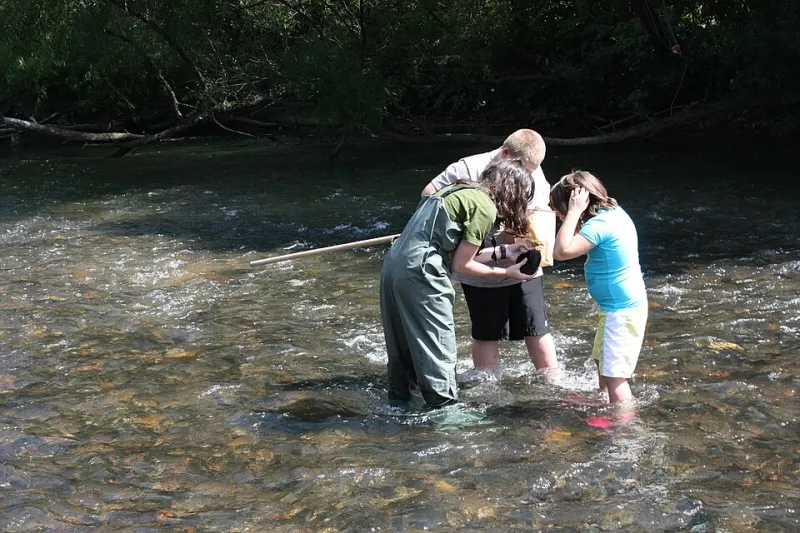
Photo: U.S. Fish and Wildlife Service Southeast Region, Public domain, via Wikimedia Commons
On a Saturday morning in late autumn, a small team gathers at a public boat launch with nets, sample bottles, a multiparameter meter, and a clipboard. They are not agency staff. They are volunteers in a stream-monitoring program, part of a broad American network that samples creeks and rivers on schedules designed to outlast budget cycles. Their work is often described as citizen science, but its most important product is simpler: continuity.
Beyond the Snapshot
Regulatory agencies monitor water quality, but their capacity is finite. Sampling rotations, laboratory costs, and shifting priorities can leave gaps in space and time. A state may sample a large river monthly and a minor tributary once every several years. Volunteers fill some of those gaps, especially in small streams that drain neighborhoods, farms, and suburban developments. A single sample is a snapshot. A volunteer network that returns to the same riffle, at the same season, for a decade or more produces something closer to a memory.
That memory matters because water quality is not a fixed condition. It responds to land use, precipitation, wastewater infrastructure, agricultural practices, and climate. Detecting change requires baseline data and repeated observations. A volunteer who records stream temperature every two weeks may notice a shift that an annual agency visit would miss. A team that counts aquatic insects year after year may detect degradation before a chemical sample does.
What Gets Measured
Volunteer stream monitoring is not a single activity. Some programs focus on water chemistry: temperature, pH, dissolved oxygen, conductivity, nitrate, phosphate, and turbidity. Others emphasize biological indicators, especially benthic macroinvertebrates—the insect larvae, snails, and crustaceans that live on stream bottoms and vary in their tolerance to pollution. Many combine chemical, biological, and habitat assessments.
The methods are deliberately accessible but not casual. Credible programs use quality assurance project plans, calibrated instruments, duplicate samples, and regular field audits. Volunteers complete training and recertification. Data may be uploaded to state portals or shared with watershed associations and local governments. The point is not to replace professional monitoring but to extend its reach and supplement it with observations that agencies cannot afford to collect.
The Civic Dimension
The data have civic uses. Watershed groups cite volunteer records in restoration plans. Local governments use them to prioritize culvert repairs or streambank stabilization. State agencies may incorporate them into broader assessments, provided the methods meet established standards. In some places, volunteer data have helped document impairments that led to further investigation.
But the civic value is not only instrumental. Monitoring teaches residents how watersheds work, how regulations function, and how local decisions affect waterways. Volunteers learn to read a discharge permit, interpret a trend line, or speak at a public meeting. They become legible to agencies, and agencies become legible to them. That mutual legibility is a form of civic learning, and it is one reason stream monitoring programs often produce leaders beyond the stream bank.
The Problem of Continuity
The paradox is that volunteer networks are built to provide continuity but often struggle to maintain it. Funding for coordinators, equipment, and lab analysis is precarious. Volunteer burnout is real. A program that depends on one charismatic organizer may collapse when that person moves. Data stored in a personal spreadsheet may be lost.
The most durable programs build institutional homes. They partner with soil and water conservation districts, universities, community colleges, or watershed associations. They document protocols and train successors. They deposit data in public repositories with clear metadata. They treat volunteers as long-term participants rather than one-time event staff.
For a river, memory is not a metaphor. It is a record of repeated observations, properly stored and openly shared. Volunteer monitors are building that record one sample at a time. Their work is a reminder that environmental knowledge is not only produced in laboratories and agencies. It is also produced by people who show up, season after season, to read the water.