Woven Into the Record: How Fiber Arts Collectives Are Stitching Cultural Memory Into Permanent Form
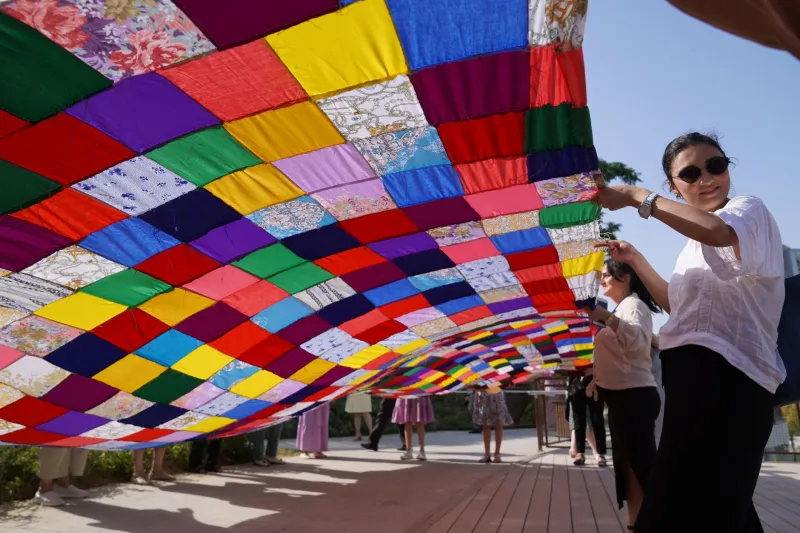
There is a particular kind of knowledge that resists the written word. It lives in the tension of a loom, in the specific angle of a needle passing through cloth, in the color choices that a grandmother made without explanation because explanation was never necessary. For generations, this knowledge moved between people through proximity and practice. Today, a growing number of community organizations across the United States are working deliberately to ensure it does not disappear — and they are doing so with thread, fabric, and collective intention.
The movement does not announce itself with a single name or a centralized institution. It manifests instead as quilting groups in Detroit church basements, Hmong weaving circles in Minneapolis community centers, and embroidery collectives in Los Angeles that gather the daughters and granddaughters of Central American immigrants. What unites them is a shared recognition: that textiles are not merely objects but documents, and that the act of making them together is itself a form of scholarship.
The Archive That You Can Touch
Conventional archives preserve paper, photographs, and recorded sound. They are built for retrieval, for the scholar who arrives with a research question and a reading room reservation. Textile archives operate differently. They preserve process alongside product, and they demand a different kind of engagement from anyone who encounters them.
The International Quilt Museum at the University of Nebraska–Lincoln holds one of the largest publicly accessible quilt collections in the world, and its curators have noted a meaningful shift in recent years: an increasing number of submissions arriving not from individual makers but from community groups, accompanied by detailed documentation of the collaborative process, the stories embedded in specific fabric choices, and the cultural contexts that give the work meaning beyond aesthetics.
This shift reflects something broader. Community organizations have begun to understand that the textile itself is only part of what must be preserved. The Anacostia Community Museum in Washington, D.C., which has long prioritized the histories of underrepresented communities, has worked with neighborhood quilting groups to develop documentation protocols that capture oral histories alongside the physical objects. The result is an archive with layers: the visual record of the quilt, the recorded voices of its makers, and the written transcriptions of the conversations that happened while needles were moving.
Immigrant Traditions and the Collaborative Imperative
For many immigrant communities, fiber arts have always functioned as a technology of cultural transmission. The challenge in the American context is that transmission requires proximity, and proximity is precisely what displacement and dispersal tend to destroy.
In the Twin Cities of Minneapolis and Saint Paul, which are home to one of the largest Hmong diaspora populations in the United States, community organizations have developed structured weaving programs that pair elder practitioners with younger participants who may have grown up with limited exposure to traditional techniques. These programs are explicitly educational: participants learn not only the mechanics of pan dau — the intricate needlework that encodes Hmong history and cosmology — but also the specific narrative vocabulary embedded in traditional motifs.
What has emerged from these programs is a body of collaborative textile work that occupies an interesting position between tradition and innovation. Some pieces reproduce historical patterns with documentary precision. Others use traditional techniques to record contemporary experiences: the journey to the United States, the experience of navigating American institutions, the particular texture of hyphenated identity. Both categories are understood by their makers as contributions to a living archive.
Similar dynamics are visible in communities with entirely different textile traditions. In Houston, which has a substantial Salvadoran immigrant population, a collective organized through a local community development organization has been producing embroidered panels that document the history of specific neighborhoods in El Salvador alongside the histories of the Houston communities where their makers now live. The panels have been exhibited at the Houston Museum of African American Culture, which has developed programming around them that connects their themes to broader questions of migration, memory, and belonging.
From Community Table to Traveling Exhibition
One of the more significant developments in this movement has been the emergence of traveling exhibitions that carry community textile projects to audiences far beyond their places of origin. These exhibitions serve multiple purposes simultaneously. They provide visibility for communities whose cultural production is frequently overlooked by mainstream arts institutions. They create opportunities for cross-cultural dialogue. And they function as fundraising vehicles that allow the organizing groups to sustain their work.
The Gee's Bend quilting tradition of Wilcox County, Alabama — long recognized by art historians as one of the most significant vernacular design traditions in American history — demonstrated decades ago that community textile work could command serious institutional attention. The traveling exhibition that originated at the Museum of Fine Arts, Houston, in 2002 and subsequently visited museums across the country is frequently cited by contemporary organizers as evidence that the barrier between community practice and institutional recognition is permeable.
More recent projects have built on that precedent while expanding the scope of what traveling exhibitions can accomplish. Several groups have developed exhibition formats that include participatory components, inviting audiences at each venue to contribute to ongoing collaborative pieces. This approach transforms the exhibition from a display of completed work into a continuing act of collective making — and extends the archive with each new venue.
The Digital Dimension
Physical textiles are vulnerable. They fade, they tear, they require climate-controlled storage. The communities producing these collaborative works are acutely aware that the objects themselves may not survive indefinitely, which has driven considerable investment in digital documentation.
Several organizations have partnered with university libraries and digital humanities programs to develop high-resolution imaging protocols that capture not only the visual surface of textile works but also their structural characteristics — the weave structure, the layering of materials, the evidence of repair and modification over time. These digital records are being deposited in publicly accessible repositories, ensuring that the knowledge encoded in the textiles remains retrievable even if the physical objects are eventually lost.
The Textile Society of America, a professional organization that bridges scholarly and community practice, has developed resources to help community groups navigate the technical and legal dimensions of digital archiving, including guidance on metadata standards and intellectual property considerations that are particularly relevant for communities whose traditional knowledge has historically been appropriated without consent or compensation.
The Knowledge That Persists
There is a pedagogical dimension to all of this that deserves explicit acknowledgment. The communities engaged in these projects are not simply preserving the past; they are transmitting a mode of knowing — one that is embodied, relational, and accumulated through practice rather than instruction. In that sense, the collaborative textile project is not merely an archive but a school.
What participants learn in these circles extends well beyond technique. They learn to read objects as documents. They learn to ask questions of materials — where did this fabric come from, why was this color chosen, what does this pattern mean to the person who taught it to me? They learn that knowledge can be held in hands as surely as in minds, and that some of what is most worth knowing is transmitted not through language but through the patient repetition of skilled movement.
For a society increasingly dependent on digital information systems that privilege text and speed, this is not a trivial lesson. It is, in fact, a form of resistance — a demonstration that not all knowledge submits to the same forms of capture, and that the communities who have always known this are worth listening to.