The Collective Table: How Community-Authored Cookbooks Are Rewriting the Economics of Culinary Knowledge
The cookbook occupies a peculiar position in American publishing. It is simultaneously one of the most commercially successful and most culturally contested genres in print. Blockbuster titles from celebrity chefs dominate bestseller lists and generate substantial revenue for large publishing houses. Meanwhile, the cuisines of communities that have contributed most substantially to the actual texture of American food culture — the dishes developed in immigrant kitchens, in communities navigating food scarcity, in traditions that predate European contact — tend to appear, when they appear at all, in formats shaped by the expectations of audiences assumed to be unfamiliar with them.
The community organizations now producing collectively authored cookbooks are responding to this imbalance, though the nature of their response varies considerably. Some are motivated primarily by the work of cultural preservation — the conviction that food knowledge is a form of heritage that deserves the same archival attention as other kinds of cultural expression. Others are driven by explicitly economic concerns: a recognition that culinary knowledge has commercial value, and that the communities who possess that knowledge have historically not been the ones who capture it. The most sophisticated projects pursue both goals simultaneously, understanding them as inseparable.
Knowledge as Curriculum
To understand why community cookbook projects belong in a conversation about learning and knowledge transmission, it is useful to consider what, exactly, a recipe encodes. On its surface, a recipe is a set of instructions. But anyone who has attempted to reproduce a dish from a written recipe alone — particularly a dish from an unfamiliar culinary tradition — quickly discovers that the instructions are incomplete. They assume a body of background knowledge: about ingredient quality and selection, about the sensory cues that indicate a preparation is proceeding correctly, about the adaptations that experienced cooks make as a matter of course without thinking to mention them.
This tacit dimension of culinary knowledge is precisely what makes its transmission challenging and its documentation valuable. When community cookbook projects work well, they develop processes for surfacing and recording this tacit knowledge — for translating the accumulated expertise of experienced cooks into forms that can travel beyond the kitchen where it was acquired.
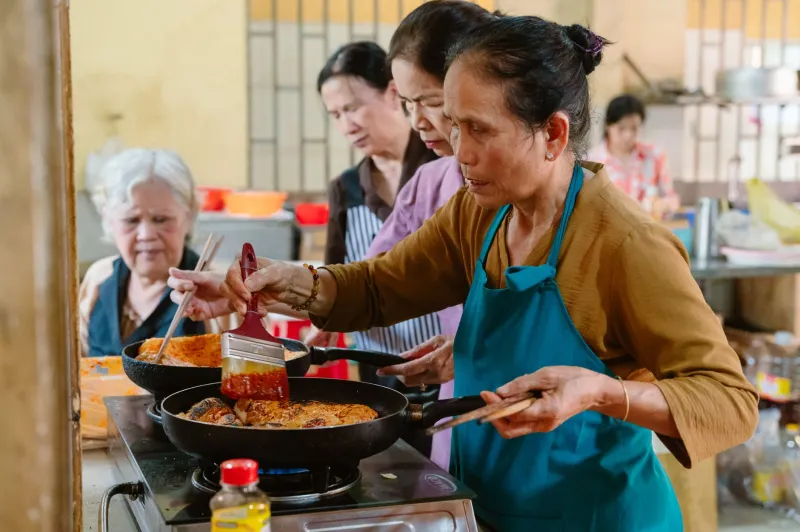
The methods that different groups have developed for this translation are themselves worth examining. Some organizations use structured interview protocols, conducting extended conversations with experienced cooks that are recorded, transcribed, and then worked into recipe narratives. Others use observation-based documentation, having community members work alongside experienced cooks and record what they observe in sufficient detail to reconstruct the process. A number of projects have experimented with video documentation as a supplement to written recipes, recognizing that some aspects of technique are more efficiently communicated through demonstration than description.
Reclaiming the Narrative
The question of who tells the story of a culinary tradition — and in whose voice, for whose audience, through whose institutional channels — is not merely symbolic. It has material consequences for the communities whose food knowledge is at stake.
The pattern that scholars of food culture have documented extensively is one in which culinary traditions developed by communities with limited access to mainstream publishing infrastructure are introduced to broader audiences through the work of intermediaries who may have significant cultural distance from those traditions. The intermediary gains the commercial benefit; the originating community gains, at best, a form of recognition that may or may not translate into economic benefit.
Community cookbook projects are one response to this pattern. By developing their own publishing infrastructure — or by negotiating agreements with publishers that give them meaningful control over content, framing, and revenue distribution — these organizations are attempting to ensure that the economic value generated by their culinary knowledge flows back to the communities that created it.
In Detroit, a cooperative of Black women food entrepreneurs has produced a cookbook documenting the culinary traditions of the city's African American community, with revenues directed to a revolving loan fund that supports food-based small businesses. The project was developed in explicit dialogue with the history of Detroit's Black Bottom neighborhood — demolished in the 1950s to make way for a freeway — and frames the recovery of culinary knowledge as inseparable from the recovery of the broader community history that was disrupted by that demolition.
In New Mexico, a nonprofit organization working with Indigenous farming communities has produced a cookbook centered on traditional agricultural products and the culinary traditions they support. The organization negotiated a publishing arrangement that retains Indigenous intellectual property rights over the traditional knowledge documented in the book — an arrangement that required significant legal work but that the organization regards as foundational to the project's integrity.
The Pedagogical Infrastructure of Collective Authorship
Producing a collectively authored cookbook is not simply a matter of gathering recipes from community members. It requires the development of a pedagogical infrastructure: processes for eliciting knowledge from people who may not think of themselves as experts, for creating shared standards that allow individual contributions to cohere into a unified publication, and for building the editorial and production capacity to bring the project to completion.
Many of the organizations engaged in these projects have found that the process of creating the cookbook is as educationally significant as the product. Participants develop skills in documentation, editing, and project management. They engage in conversations about their own culinary traditions that surface knowledge they had not previously articulated. They encounter the traditions of other community members and develop a more complex understanding of the cultural landscape they inhabit.
Several organizations have developed explicit curriculum frameworks around their cookbook projects, integrating them into broader community education programs. A community organization in Chicago working with Puerto Rican and Mexican communities on the city's Northwest Side has developed a program in which the cookbook project serves as the anchor for a curriculum that includes food history, nutrition, small business development, and food policy advocacy. Participants leave the program with a contribution to a published book, a set of practical skills, and a more sophisticated understanding of the systems that shape food access and food culture in their community.
Distributed Knowledge, Shared Ownership
The emergence of accessible self-publishing platforms has significantly lowered the barriers to community cookbook production. Organizations that might have struggled to find a commercial publisher — or that might have found the terms of commercial publishing unacceptable — can now bring their projects to print without institutional intermediaries. Print-on-demand services eliminate the need for large upfront investments in inventory. Digital distribution through platforms like Amazon and IngramSpark provides access to audiences that would previously have required a traditional publisher's distribution network.
This democratization of publishing infrastructure has enabled a proliferation of community cookbook projects that would simply not have been viable a generation ago. It has also created new challenges around discoverability and marketing — challenges that some organizations have addressed through partnerships with independent bookstores, food cooperatives, and community organizations that serve as distribution points.
The projects that have navigated these challenges most successfully tend to be those with the clearest sense of their intended audience and the most developed relationships with the communities they serve. A cookbook produced by and for a specific community, distributed through channels that community members already use, can build a readership without the marketing infrastructure that mainstream publishing provides — and can retain the economic benefits that mainstream publishing would otherwise capture.
The Recipe as Research
There is a dimension of community cookbook projects that tends to be underappreciated in discussions focused on their economic and cultural significance: their contribution to the systematic documentation of food knowledge. The best of these projects are, in a meaningful sense, research projects — efforts to gather, verify, and organize knowledge that has previously existed only in distributed, informal form.
The standards of evidence that govern this research are different from those of academic food scholarship, but they are not absent. Community cookbook projects typically involve processes of cross-checking among contributors, of testing recipes to ensure reproducibility, and of contextualizing individual recipes within broader cultural and historical frameworks. The result is a form of knowledge that is both more accessible and more practically useful than academic food history — and that, at its best, contributes to academic understanding as well as community practice.
Universities with strong food studies programs have begun to recognize this, and a number of collaborative relationships between academic institutions and community cookbook projects are now producing work that neither party could have accomplished independently. These collaborations are still relatively rare, but they point toward a model of knowledge production that takes seriously the expertise that communities possess about their own culinary traditions — and that finds ways to honor that expertise without appropriating it.