Curb Appeal for the Mind: How Free Little Libraries Are Evolving Into Neighborhood Knowledge Ecosystems
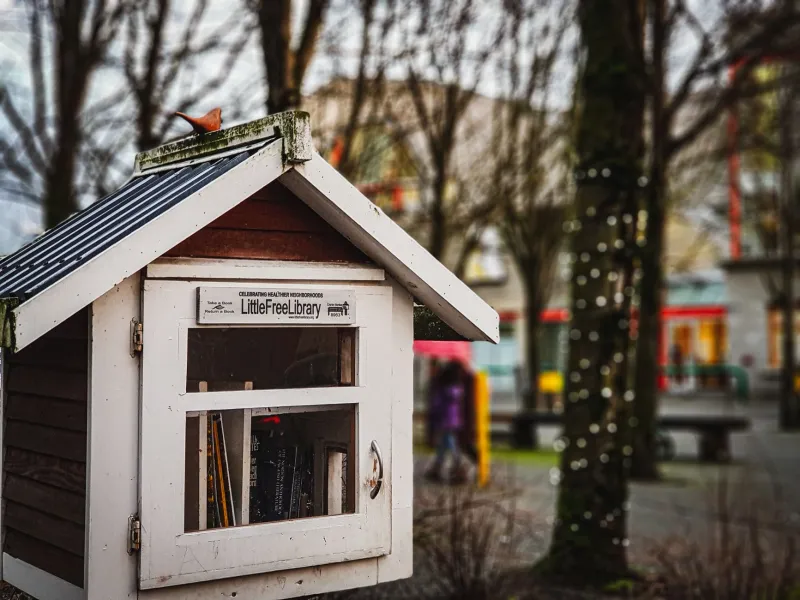
On a quiet street in Decatur, Georgia, a retired schoolteacher named Marguerite maintains what she calls her "reading post" — a hand-painted cedar cabinet mounted on a four-by-four outside her front door. To a passing driver, it looks like any of the roughly 150,000 registered Free Little Libraries now dotting American neighborhoods. Look closer, and you will find something more deliberate: a laminated index card inside the door that lists every title currently available, a QR code linking to a shared spreadsheet her block association updates weekly, and a small notebook where visitors are invited to write what they borrowed and what they left behind.
Marguerite is not an anomaly. She is part of a growing cohort of what might reasonably be called backyard librarians — ordinary residents who have taken a whimsical cultural phenomenon and begun applying to it the logic of professional information science. Their efforts, largely uncoordinated and entirely volunteer-driven, are producing something that formal institutions have rarely managed to achieve: a granular, street-level record of what people in specific communities actually want to read.
From Novelty to Infrastructure
The Free Little Library movement traces its origins to 2009, when a Wisconsin man named Todd Bol built a small schoolhouse-shaped box in his yard to honor his late mother, a teacher and avid reader. The concept spread virally, incorporated as a nonprofit in 2012, and has since registered installations in all fifty states and more than one hundred countries. For most of the movement's history, the boxes functioned as charming but essentially passive objects — a book goes in, a book comes out, and the transaction leaves no trace.
What is changing now is the ambition of the stewards. Increasingly, hosts are treating their installations not merely as drop points but as active nodes in a neighborhood information network. Some maintain digital catalogs on platforms like LibraryThing or simple Google Sheets shared with neighbors. Others have formed informal alliances, creating circuits of three, four, or a dozen boxes within walking distance of one another, each with a slightly different curatorial focus. One such network in Portland, Oregon, has designated specific boxes for Spanish-language titles, graphic novels, and local history — a division of labor that emerged organically from conversations among hosts.
The Data No Algorithm Captures
Perhaps the most intellectually significant dimension of this evolution is the kind of knowledge these networks are beginning to generate. Commercial recommendation engines — the algorithms that power Amazon, Goodreads, and the major streaming platforms — are exceptionally good at telling individuals what they are likely to enjoy based on prior behavior. What they cannot do is reveal what a specific block, zip code, or demographic pocket is hungry for but has never been offered.
Front-yard micro-libraries, cataloged and tracked by attentive stewards, can do exactly that. When a host in a working-class neighborhood in Cleveland notices that every copy of a particular genre disappears within twenty-four hours while literary fiction sits untouched for weeks, that observation carries information no purchase history can supply. It reflects not just preference but access — what people will read when given the opportunity, regardless of what the market has historically assumed they want.
Researchers at several library science programs have begun paying attention. A collaborative project led by faculty at the University of Illinois Urbana-Champaign is currently mapping Free Little Library density against public library branch locations and census data on broadband access, attempting to determine whether front-yard installations are genuinely supplementing formal library infrastructure in underserved areas or clustering, as critics have sometimes alleged, in already resource-rich neighborhoods. Early findings suggest the answer is complicated — and that host behavior matters enormously in determining which outcome prevails.
Curating for Community, Not Commerce
What distinguishes the most effective backyard librarians from casual participants is intentionality about collection development — a phrase that sounds technical but describes something quite human: the decision to stock a shelf not with whatever happens to be available, but with what a specific community needs and might not otherwise encounter.
In a predominantly immigrant neighborhood in the Pilsen area of Chicago, one host has made it her practice to solicit donations specifically of bilingual children's books and adult English-language learning materials, filling a gap she identified after noticing that the nearest public library branch had reduced its Spanish-language collection due to budget constraints. In rural Appalachian communities, where library branches can be thirty or forty miles distant, some hosts have begun stocking practical reference materials — medical dictionaries, legal guides written for lay readers, agricultural handbooks — alongside fiction.
These decisions are not made in isolation. The most active stewards tend to be embedded in informal networks of communication with their neighbors: neighborhood association email lists, local Facebook groups, NextDoor threads. The front-yard library becomes, in this context, a physical anchor for a broader conversation about what the community values and what it lacks.
The Serendipity Argument
There is a dimension of the micro-library experience that resists quantification but deserves acknowledgment: the encounter with the unexpected. In an information environment increasingly shaped by personalization, the Free Little Library operates on an entirely different logic. You approach the box not knowing what you will find. The book that changes your thinking may be one you would never have searched for, recommended by no algorithm, suggested by no friend — simply present, by accident, on a neighbor's shelf.
This quality of serendipitous discovery has long been celebrated as one of the virtues of physical libraries and independent bookstores, and it is not incidental to the educational mission that the best micro-library stewards articulate. Learning, as cognitive scientists have noted, is rarely a linear process of seeking and finding. It is often ignited by the oblique encounter — the title glimpsed sideways, the subject stumbled into, the perspective absorbed before one knew one needed it.
Toward a More Connected Commons
The backyard library movement, at its most developed, points toward something that formal educational institutions have long aspired to and rarely achieved: a genuinely distributed knowledge commons, maintained not by professionals operating within institutional constraints but by neighbors acting from conviction and curiosity.
The challenges are real. Sustainability depends on the energy of individual hosts, and turnover is high. Equity of access remains uneven. And the absence of coordination means that lessons learned in one neighborhood rarely travel efficiently to another.
Yet the trajectory is instructive. What began as an act of individual generosity — a box of books on a post, offered freely to whoever passes — is, in the hands of its most committed practitioners, becoming something closer to a civic institution. One built not from the top down, but from the curb up.