Words in Motion: The Community Volunteers Crowdsourcing the Living Lexicons of Immigrant America
A Language Born on the Block
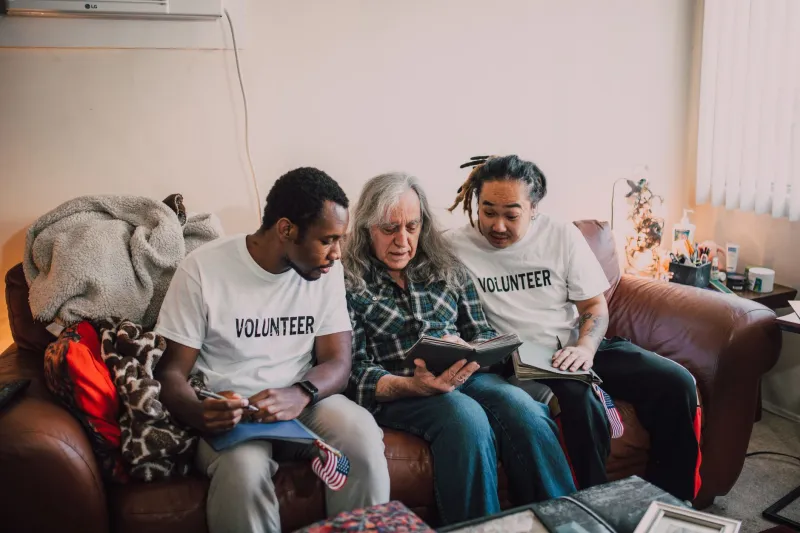
In a strip-mall community center in suburban Houston, a retired schoolteacher named Miriam spends two evenings each week doing something that no university linguistics department has yet assigned to a graduate student. She sits across from elderly Vietnamese American residents, a voice recorder between them, and asks a deceptively simple question: What do you call that?
The answers she receives rarely appear in any published dictionary. A particular gesture of respectful greeting adapted for American doorways. A word for the specific exhaustion of translating not just language but entire cultural frameworks for one's own children. A term of affection borrowed from Spanish-speaking neighbors two streets over, folded so naturally into daily Vietnamese conversation that younger residents assume it has always been there.
Miriam is one of a growing number of community volunteers across the United States who are undertaking what might be called hyperlocal lexicography — the systematic documentation of the living, evolving, and often ephemeral languages that emerge when immigrant communities take root in American soil.
The Gap That Institutions Leave Behind
Formal linguistics has long studied language contact and code-switching, the phenomenon by which multilingual speakers blend two or more languages within a single conversation. Academic literature on Spanglish, Hinglish, and Vietnamese-American vernacular exists in peer-reviewed journals. Yet professional researchers face inherent limitations: they arrive from outside the community, they work within grant cycles, and their methodologies — however rigorous — can struggle to capture the organic, moment-to-moment texture of how a neighborhood actually speaks.
Community-based language archivists occupy a different position entirely. Many are themselves members of the neighborhoods they document, or have lived alongside immigrant communities for decades. Their access is relational rather than institutional. A neighbor will describe, with ease and specificity, a word she would never use in the presence of an outside researcher holding a clipboard.
This intimacy of access is precisely what makes grassroots lexicography so valuable — and why a number of digital platforms have emerged to support it. Projects modeled loosely on the open-contribution architecture of crowdsourced reference tools now allow community members to submit entries, provide audio recordings of correct pronunciation, and annotate definitions with the social context in which a given term is appropriately used.
More Than Slang: The Cultural Weight of Words
It would be a mistake to characterize this work as merely the cataloguing of colorful slang. The linguistic material these volunteers are preserving carries the full weight of immigrant experience in America.
Consider the category of words that describe states of being for which English provides no precise equivalent. Researchers working with Somali American communities in Minneapolis have documented terms describing the specific emotional complexity of sending remittances home — a practice that is simultaneously an act of love, obligation, sacrifice, and connection across an enormous geographic and experiential distance. No single English word captures this. Neither, strictly speaking, does the original Somali term, which has itself evolved in the American context to encompass new layers of meaning.
Or consider the naming conventions that emerge at cultural intersections. In certain South Asian American communities in New Jersey, volunteers have documented the emergence of hybrid kinship terms — forms of address for relationships that exist in Indian family structures but have no English equivalent, now rendered in phonetically Americanized forms that the original languages would not recognize. These terms are functional, affectionate, and entirely invisible to the broader culture.
To document them is to insist that they matter.
The Technology Enabling the Work
The tools available to contemporary community lexicographers have expanded considerably in recent years. Smartphone audio recording has made it practical for volunteers without formal training to capture high-quality pronunciation samples during ordinary conversations. Cloud-based collaborative platforms allow geographically distributed contributors — community members who have since relocated, or diaspora members in other cities — to add entries, flag inaccuracies, and provide regional variants.
Some projects have developed simple mobile applications that allow any community member to submit a word, its definition, an example sentence, and an audio clip in a matter of minutes. Moderation is handled by small editorial committees drawn from within the community itself, ensuring that the authority to define a word remains with those who use it.
The resulting archives are, by design, different from conventional dictionaries. They are explicitly living documents, with entries dated and versioned so that the evolution of a term over time becomes part of the record. A word documented in 2018 may carry a different connotation by 2024, and the archive preserves both iterations rather than replacing one with the other.
Preservation, Identity, and the Urgency of Now
The volunteers engaged in this work frequently describe a sense of urgency that gives the project its emotional core. Language shift in immigrant communities is well-documented: first-generation speakers maintain their native language with relative fluency, second-generation speakers are typically bilingual with English dominant, and by the third generation, the heritage language is often reduced to scattered phrases and ceremonial use.
The hybrid vernacular that emerges during the first and second generations — the blended, improvisational, neighborhood-specific language that Miriam records in Houston — is particularly vulnerable. It is neither the formal heritage language that language preservation organizations typically prioritize, nor standard American English. It exists in a linguistic middle ground that is easy to overlook precisely because it functions so naturally for those who use it.
Yet it is in this middle ground that much of the lived experience of immigration in America resides. The words invented to navigate bureaucratic systems that were not designed with immigrant users in mind. The terms of endearment that cross language lines because affection does not wait for translation. The neighborhood nicknames for institutions, intersections, and community figures that constitute a shared geography of belonging.
To let these words disappear unrecorded is to allow a significant portion of American experience to pass without acknowledgment.
A Collaborative Model Worth Scaling
What is perhaps most instructive about this movement — from the perspective of those interested in how communities generate and preserve knowledge — is its fundamentally collaborative architecture. These projects do not place a single expert at the center. They distribute authority widely, treating every native speaker as a legitimate source and every community member as a potential contributor.
This model reflects a broader understanding of what it means to advance knowledge in service of communities rather than simply about them. The lexicons being built in Houston and Minneapolis and New Jersey are not primarily academic resources, though scholars will certainly find them useful. They are community acts of self-documentation — declarations that the linguistic lives of immigrant Americans are worth the effort of careful preservation.
For the organizations and individuals who believe that knowledge belongs to the communities that generate it, these backyard linguists offer a compelling example of collaborative discovery at its most essential.