Around the Table, Before the Podium: How Deliberative Supper Circles Are Reshaping Civic Engagement in American Cities
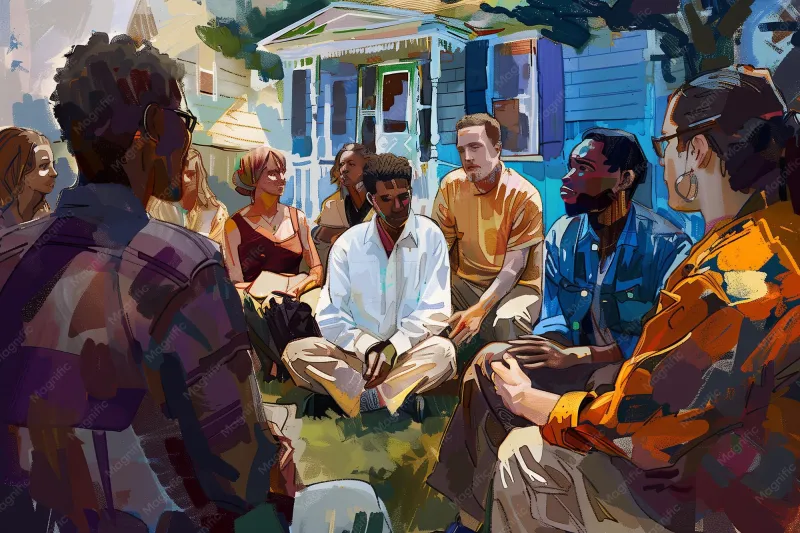
Photo: diverse neighbors gathered around dinner table discussing community documents papers, via img.freepik.com
A Different Kind of Public Comment
The conventional town hall has a well-documented problem. Attendance skews toward the retired, the professionally flexible, and the already-organized. Speakers are allotted three minutes at a microphone, often after hours of procedural business, to address officials who may or may not be listening. The format privileges confrontation over deliberation and volume over nuance. For many residents—particularly those working multiple jobs, managing childcare, or navigating language barriers—the town hall is not a viable form of civic participation.
Something different is happening in a growing number of American cities. In Minneapolis, Minnesota, a network of roughly thirty neighborhood supper circles has been meeting monthly for three years to research, debate, and collectively synthesize positions on issues scheduled to come before the city council. In Albuquerque, New Mexico, a similar effort organized through a community foundation has produced detailed policy briefs on affordable housing and public transit that have been formally entered into the municipal record. In Richmond, Virginia, supper circles convened by a local nonprofit have contributed testimony to school board hearings that participants describe as more substantive and more representative than anything produced through official public comment processes.
These groups are not lobbying organizations. They do not advocate for predetermined positions. What they share is a commitment to structured deliberation—a process in which participants first learn together, then reason together, and only then attempt to reach shared conclusions.
The Mechanics of Structured Deliberation
The format varies by community, but most supper circles follow a recognizable pattern. A facilitator—often a trained volunteer rather than a professional—introduces a policy question scheduled for upcoming municipal action. Participants receive a briefing packet prepared in advance by a rotating research team drawn from the group itself. The packet typically includes a plain-language summary of the issue, relevant data from public sources, and a range of perspectives including those likely to be underrepresented in official proceedings.
The meal is not incidental. Research on deliberative democracy consistently suggests that shared eating reduces social defensiveness and encourages the kind of exploratory conversation that formal meeting environments tend to suppress. Participants are more likely to revise their initial positions, to ask genuine questions, and to acknowledge the legitimacy of perspectives they disagree with when seated at a table with food in front of them than when standing at a lectern.
Following dinner, the group moves into structured discussion. Facilitators use techniques drawn from the field of deliberative democracy—including "steelman" exercises, in which participants are asked to articulate the strongest version of a position they personally oppose, and "interest mapping," which distinguishes between stated positions and underlying concerns. Notes are taken, disagreements are documented alongside areas of consensus, and a summary is circulated to participants before any public submission is finalized.
Research as a Shared Practice
What distinguishes supper circles from informal neighborhood gatherings is the deliberate cultivation of shared knowledge. Most groups assign research responsibilities in advance of each meeting, distributing the work of finding and synthesizing information across participants with different skills and schedules. A retired teacher might analyze school budget documents. A nurse might summarize public health data. A small business owner might research the economic impacts of a proposed zoning change. A recent immigrant might document how similar policies have functioned in other municipalities.
This distributed research model has two important effects. First, it ensures that the group's deliberations are grounded in evidence rather than rumor or anecdote. Second, it builds civic capacity among participants who may never have engaged seriously with municipal data before. Several supper circle participants interviewed for this article described the research process itself—learning to read a city budget, understanding how an environmental impact assessment is structured, tracing the history of a zoning ordinance—as transformative.
"I had lived in this city for twenty years and never actually read a school board agenda," said one participant in a Minneapolis supper circle that focused on a proposed boundary redistricting. "Once I did, I realized the decision was much more complicated than the coverage suggested, and that my initial reaction had been based on incomplete information."
Reaching City Hall
The ultimate measure of these groups is whether their work influences the decisions being made in their name. The evidence is mixed but encouraging. In Albuquerque, the housing brief produced by a coalition of supper circles was cited by two city councilors during floor debate and contributed to an amendment that expanded income eligibility thresholds in a new affordable housing ordinance. In Richmond, school board members have acknowledged incorporating supper circle testimony into their deliberations on curriculum policy, noting that the submissions were more detailed and more representative of diverse community perspectives than typical public comment.
Not every effort has produced measurable policy outcomes, and participants are generally realistic about the limits of informal civic engagement. Municipal decisions are shaped by many forces—legal constraints, budget realities, political pressures—that no amount of community deliberation can fully counteract. But advocates for the model argue that influencing outcomes, while welcome, is not the primary measure of success.
"The point is to build a community that knows how to think together about hard problems," said the director of a community foundation in Albuquerque that has supported supper circle development. "Whether or not a specific brief changes a specific vote, you have created a group of people who understand the issue more deeply, who trust each other more, and who are more likely to stay engaged over time."
A More Representative Room
Perhaps the most significant claim made by supper circle organizers is that their gatherings are more demographically representative than traditional civic participation venues. The evidence for this claim is anecdotal but consistent. By meeting in homes, community centers, and houses of worship rather than city hall; by providing food, childcare, and multilingual facilitation; and by scheduling meetings at times accessible to working residents, supper circles have attracted participants who rarely appear at town halls.
This representational dimension matters not merely as a matter of fairness but as a question of epistemic quality. Decisions made with input from a broader range of lived experiences are, the argument goes, more likely to anticipate unintended consequences and to reflect the actual complexity of community life. If that claim holds, then the supper circle is not merely a supplement to formal democratic process. It may be a corrective to one of that process's most persistent failures.